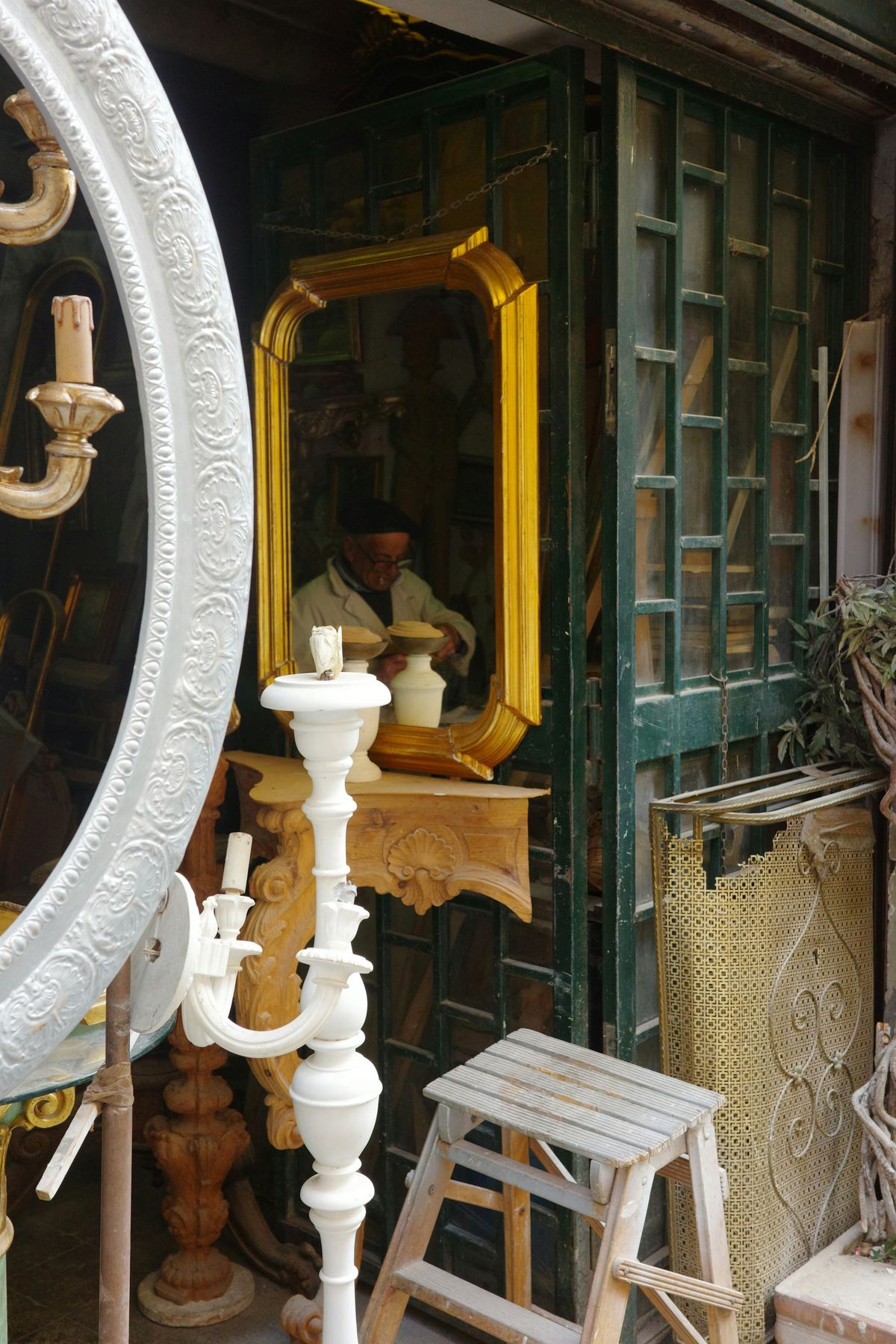
How do you date a French mirror at the flea market?
To tell a period French mirror from a later one, look at four things in this order: the glass, the silvering behind it, the back of the frame, and the gilding. The frame style alone proves almost nothing, because Louis XV and Louis XVI models were reproduced all through the 19th and 20th centuries and are still made today.
The usual risk is not fraud. It is a mismatch between what the label says, what the price assumes and what your project needs: a replaced plate priced as original, a regilded frame priced as untouched, an overmantel too tall for the room.
Is the glass old?
Hold a coin or the tip of a key against the surface and look at the gap between the object and its reflection. The gap shows the thickness of the plate. Old hand-made plates vary in thickness from one edge to the other; modern float glass is perfectly even.
Then look across the surface at a low angle. Old plates carry slight waves, small bubbles and seeds, and a faintly grey or green cast in the edge. Bevels on old mirrors were ground by hand and are often shallow and a little irregular along their length. A crisp, deep, perfectly regular bevel usually means a replacement plate, which is common and not a problem in itself, but it changes the price.
Large 18th-century overmantels and pier glasses were often built from two or three plates set edge to edge, because a single large plate was expensive or simply not available. A joined plate on a big Louis XV or Louis XVI mirror is a good sign. A single large plate in the same frame is worth a question to the dealer.
Mercury or silver backing?
Until the 19th century, mirrors were backed with a tin and mercury amalgam. Chemical silvering came in during the mid-19th century and took decades to replace amalgam fully (AIC conservation wiki). The two age differently, and that difference is one of the most reliable dating clues you have at a stall.
An amalgam mirror reflects a little less light and looks slightly blue-grey. As it decays, it shows a glittering, crystalline surface, grey or brownish bands, and sometimes tiny holes you can see when light comes from behind. A silvered mirror looks warmer, more yellow, and ages with dark spots and foxing that spread from the edges.
A mercury-backed plate in a frame sold as 18th century is consistent with a plate made before 1900, not proof of an earlier date. And an amalgam mirror is a hazard if mishandled: liquid mercury can collect at the bottom of the frame, and mercury vapour is toxic. Ask for it to be crated as is, and make sure your restorer knows what it is before anyone scrapes or resilvers it.
What does the back tell you?
Turn the mirror around.
On an old frame, the backboards are usually solid wood, often pine or oak, planed by hand and darkened by oxidation, with uneven edges. Nails and screws should match the period: hand-forged nails with irregular heads on older pieces, machine-made ones later. Look at the tone of the wood in the screw holes and at the edges of the boards. Fresh wood under an old surface means something was taken apart and rebuilt.
Plywood, staples, modern hanging hardware and a clean, even back do not rule a mirror out. Many fine frames were re-backed when the glass was changed. But they tell you the plate and the frame may not have spent their lives together, and the price should reflect that.
Water gilding, oil gilding or paint?
On the best French frames, gold leaf was laid over layers of gesso and burnished in places to a bright shine, with other areas left matt. That contrast between polished highlights and soft recesses is the signature of water gilding. Oil gilding has a more even, satin finish. Gold paint, common on later and cheaper frames, looks flat and slightly gritty, and wears to a brownish tone rather than revealing the red or ochre bole under the leaf.
Look at the worn high points, the corners and the crests. On an old gilded frame, rubbing reveals layers: gold, then a coloured bole, then white gesso. Fresh, uniform gold over everything usually means a regilding. A good regilding by a French doreur is sound work and can be the right choice for a hotel lobby. It just should not be priced as untouched original surface.
Also check the ornament itself. Much 19th-century decoration, including most Napoleon III overmantels, is moulded composition applied over wood rather than carved. That is normal for the period. Compare chips: carved wood shows grain at a break, composition shows a chalky, uniform core.
Which mirror for which project?
| Type | What it is | What to check first |
|---|---|---|
| Louis XV and Louis XVI style | Carved and gilded frames, period or later reproductions | Glass, backing and back of the frame, since the style was copied for two centuries |
| Napoleon III overmantel | Tall gilded mirrors made for Haussmann-era fireplaces, 1850s to 1870s and after | Height against your ceiling, composition ornament damage, fit on the mantel |
| Trumeau | Mirror combined with a painted or carved panel, often above a fireplace or between windows | Whether panel and mirror belong together, condition of the painted surface |
| Venetian style | Etched and cut glass frames, mostly 20th century in the Puces | Missing or replaced glass elements, which are hard to match |
| Bistro and shop mirrors | Large plain or lightly framed plates from cafés and shops | Silvering condition across the whole plate, weight and access route on site |
Measure, then measure again
Overmantels are tall. A mirror that looks proportionate in an alley at Biron may be 30 centimetres too high for a ceiling in London. We measure every piece in hand, with height, width and depth at the deepest ornament, and check it against your elevations and your access route: stairs, lift, door widths.
Getting a mirror home in one piece
Mirrors travel in a crate built to size, never wrapped alone. On large or very fragile pieces the shipper may remove the plate and crate it separately. Condition is photographed before crating, and the shipment is insured door to door. Our shipping guide covers modes and transit times.
On paperwork, two rules apply. In the United States, antiques of an age exceeding 100 years fall under a duty-free tariff heading (HTS 9706), so the dealer's invoice should state the period clearly. Leaving France, most antiques only need a French export certificate above an age and value threshold set by the Ministry of Culture; for general antiques over 50 years old that threshold has been €100,000 since 2021 (Ministère de la Culture), well above the price of most flea market mirrors. Shipping outside the EU, including to the US or the UK, also requires an EU export licence above €50,000 for antiques over 50 years old (Regulation (EC) 116/2009, Annex I). We check which rule applies to each piece before you buy.
Want us to look for one?
Send us the wall: height, width, ceiling height, a photo of the room and your budget range. We walk Biron, Paul Bert Serpette and Dauphine with it, check glass, backing and gilding on each candidate, and send a video shortlist within 72 hours, with the back of every mirror filmed as well as the front. Send the brief.