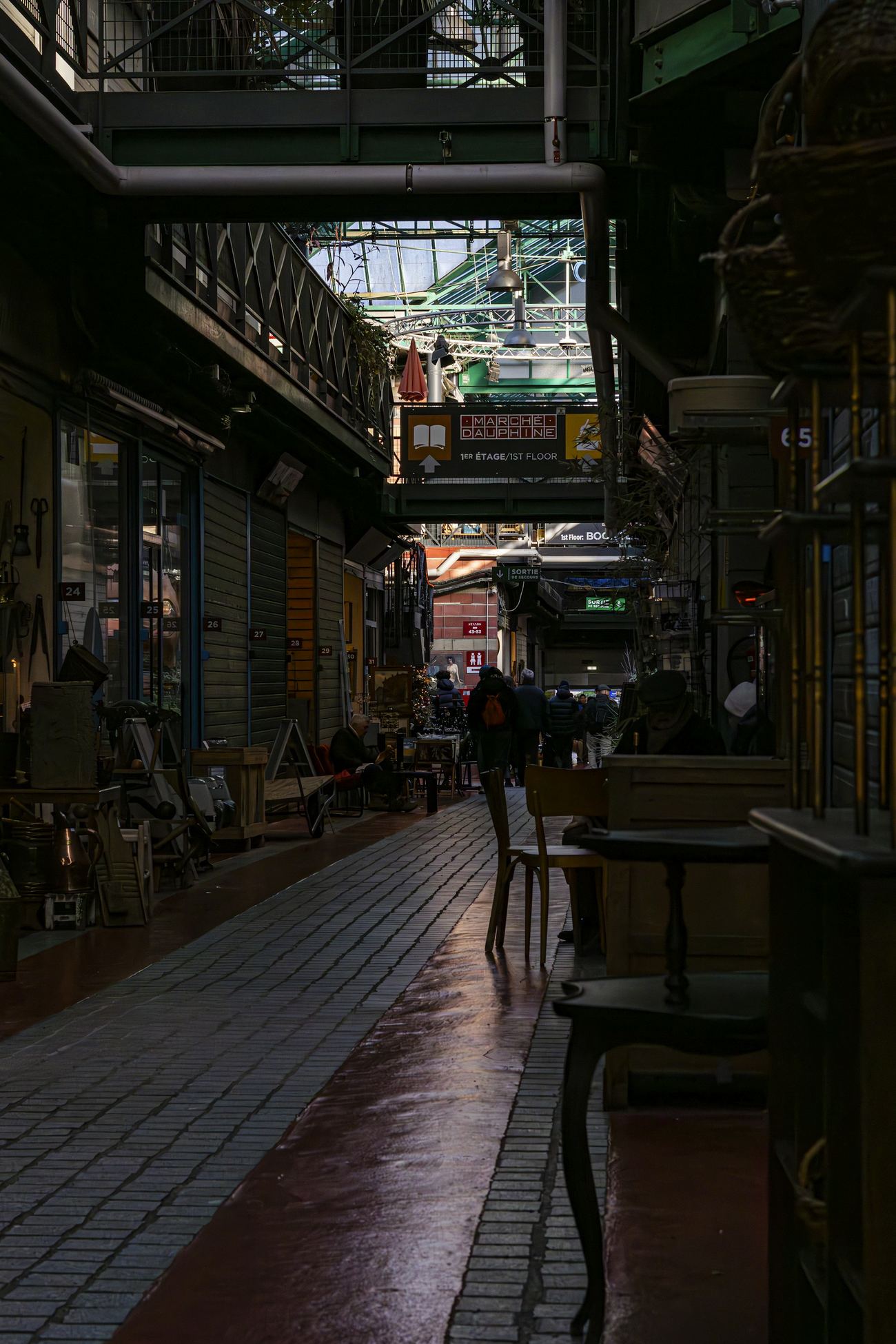
What the Puces actually are
The Marché aux Puces de Paris Saint-Ouen is not one market but a district: around a dozen covered and open-air markets and five streets, just north of the Porte de Clignancourt. It is the largest concentration of antique and vintage dealers in the world, with somewhere between 1,500 and 2,000 traders depending on how you count.
For a designer, that density is the point. In one morning you can compare three dealers of French mid-century lighting, find a pair of Napoleon III mirrors and a stack of old linen, and have them all collected by the same shipper. It is also why the Puces are easy to get wrong on a short visit: the best pieces are spread thin across hundreds of stands, and many dealers keep their best stock off the floor.
Which market for what
| Market | Best for | Price level |
|---|---|---|
| Paul Bert Serpette | 20th-century design, mid-century furniture and lighting, statement pieces, garden and industrial | Mid to high |
| Biron | Classic French antiques: 18th and 19th-century furniture, mirrors, Napoleon III, decorative arts | High |
| Vernaison | Small objects, tableware and silver, textiles, prints, curiosities | Accessible to mid |
| Dauphine | A covered mix: Art Deco, books and prints, lighting, furniture across price points | Accessible to high |
| Malassis | Covered market, decorative arts and 20th-century furniture in good condition | Mid to high |
| Jules Vallès | Vintage, curiosities, everyday antiques | Accessible |
| L'Usine | A trade warehouse open on weekday mornings, raw stock bought by dealers | Trade |
When to go
The markets are open to the public from Saturday to Monday, broadly 10:00 to 18:00, with hours that vary from one market to another. Friday mornings are partly open and are when many dealers buy from each other. Saturday is the busiest day. Monday is quieter, with fewer stands open but more time to talk.
If you are sourcing for a project, the useful time is early: before the crowds, when dealers are setting out new stock and have time for a real conversation about a piece, its history and its price.
How prices and negotiation work
Prices on tags are a starting point. There is usually room for discussion, more for several pieces from one dealer, for cash-equivalent payment, or when the dealer knows you will come back. Trade buyers are treated differently from passing visitors, and that relationship is built in French, over years.
Many dealers speak little English. That is the single biggest reason designers delegate: the conversation that gets a better price, the story of a piece or first look at stock not yet on the floor happens between regulars, in French.
What to check before buying
- Period versus later copy: construction, wear patterns, hardware, marks and labels.
- Restorations: replaced veneers, re-gilding, new marble tops, rewired lamps. Not bad in themselves, but they change the value.
- Condition: woodworm, structural repairs, mirror silvering, upholstery and springs.
- Electrics: vintage lighting usually needs rewiring to your country's standard.
- Dimensions: measured in hand, not estimated from a photo, against your drawings and access routes.
Paying, collecting and shipping
Dealers take card, transfer and sometimes cash. Pieces are usually held for a few days, then collected by a shipper who consolidates everything bought across the markets, wraps or crates it and ships it by road, air or sea. Several fine-art shippers work right around the markets.
For shipments outside the EU, you will need dealer invoices with clear descriptions, and for high-value cultural goods above legal age and value thresholds a French export certificate. See our guide to shipping antiques from Paris.
Getting there
Métro line 4 to Porte de Clignancourt or line 13 to Garibaldi, then a short walk. The main axis is the rue des Rosiers, where most covered markets have their entrance.
Doing it remotely
If you cannot be in Paris, or cannot be there often enough, we do this for you: sourcing on brief, live video hunting where you walk the alleys with us from your studio, or a private tour when you are in town.
Questions
What days is the Paris flea market open?
The Marché aux Puces de Saint-Ouen is open to the public from Saturday to Monday, broadly 10:00 to 18:00, with hours varying by market. Friday mornings are partly open, mostly for the trade.
Which part of the Paris flea market is best for mid-century design?
Paul Bert Serpette is the main destination for 20th-century and mid-century design, lighting and statement furniture. Dauphine and Malassis also have good dealers.
Do dealers at the Paris flea market speak English?
Some do, many speak little English. Negotiation and trade relationships happen mostly in French, which is why many designers use a local buying agent.
Can I ship furniture from the Paris flea market abroad?
Yes. Specialist shippers around the market consolidate, crate and ship purchases worldwide by road, air or sea, with the export paperwork.