Can you furnish a restaurant with vintage bistro chairs from Paris?
Yes, but plan for a family of chairs rather than one identical set. A dealer with forty matching chairs in stock does happen at Saint-Ouen, but not often enough to build an opening date around it. The reliable method is to agree a matching tolerance first, assemble the run across several dealers, and have every chair reglued and tightened before it ships.
Whether a chair holds up in service depends on three things: its joints, its seat and its height against your tables. Those are what we film on every chair we shortlist.
Which bistro chairs will you find at the Puces?
Almost all are bentwood: beech steamed and bent into hoops, then screwed together rather than jointed. The model comes from Vienna, where Thonet industrialised it in the 19th century, and French factories made it by the hundred thousand in the 20th. One of the largest was Baumann, which Émile Baumann took over as a small furniture works in Colombier-Fontaine, in the Doubs, in 1901. Bentwood went into mass production at the end of that decade, and by the early 1960s the factory turned out 500,000 pieces a year. It closed in December 2003 (regional heritage inventory, Bourgogne-Franche-Comté).
Most café chairs at the Puces are French and date from the interwar years to the 1960s, not 19th-century Vienna. Some still carry a maker's label or a stamp under the seat ring. A chair sold as early Thonet should have the label or stamp to prove it, and is priced as a collector's piece, which a dining room of 60 covers does not need.
Three seat types turn up: cane, pressed plywood with an embossed pattern, and wood or plywood with a padded leatherette or fabric seat. Cane is the look people ask for. In commercial use it is also the first to wear through; pressed plywood lasts longest.
Can you get 40 matching chairs?
Sometimes from one source, usually not. Before we start, we agree which of three levels you can accept:
| Tolerance | What it means | How long it takes |
|---|---|---|
| Strict match | Same maker, same model, same seat, same finish | Longest; depends on finding one large lot |
| Same model, mixed finish | Same back and seat profile, tones that vary, unified later by refinishing | A few weeks, depending on quantity |
| One family, mixed backs | Bentwood chairs of similar height and colour, different back designs | Fastest; the look many Paris cafés actually have |
A deliberate mix often looks more like a real Paris café than a perfect run of 60, which can read as reproduction.
Whatever the level, we number every chair, film it from the front, the back and underneath, and measure the seat height of each one. Old chairs of the same model can differ by a centimetre or two after decades of wear and repair, and you notice it at a long banquette table.
Will a 70-year-old chair survive restaurant service?
A well-restored one, yes. A chair bought as found, often not. Bentwood fails in predictable places, and those are where we look at the stall.
The joint where the back hoop meets the seat ring. Loose screws and enlarged screw holes here are the most common fault. They can be repaired, but a hoop cracked at the screw is harder to fix.
The leg ring, the hoop that braces the four legs. If it is missing, cracked or held with modern nails, the chair will rack under use.
The feet. Worn or split feet change the height and make the chair rock. Look at all four.
Old repairs. Metal brackets, glue drips and filler at the joints mean the chair has already failed once.
Every chair we buy for a restaurant goes to a restorer at or near the market before it is crated: joints reglued, screws replaced where needed, feet levelled, cane or seats redone if worn. Count that work in the timeline. On a run of several dozen chairs it takes weeks.
If the chairs get seat pads or new upholstery, the foam and fabric have to meet the fire rules where the restaurant is, not where the chair was made, and old fillings are unlikely to. The specification belongs to your fire consultant: send it to us before reupholstery and our upholsterer works to it.
What about bistro tables?
French bistro tables are usually a marble or stone top on a cast-iron pedestal base. Check three things: chips on the edge of the top, the weight of the base against the size of the top (a light base under a large top tips), and the height. Old café tables are often a little lower than modern dining tables, so measure them against the chairs you are buying.
Tops and bases travel separately. Each top is crated on its own, because marble cracks if it flexes.
Where do bistro chairs turn up at Saint-Ouen?
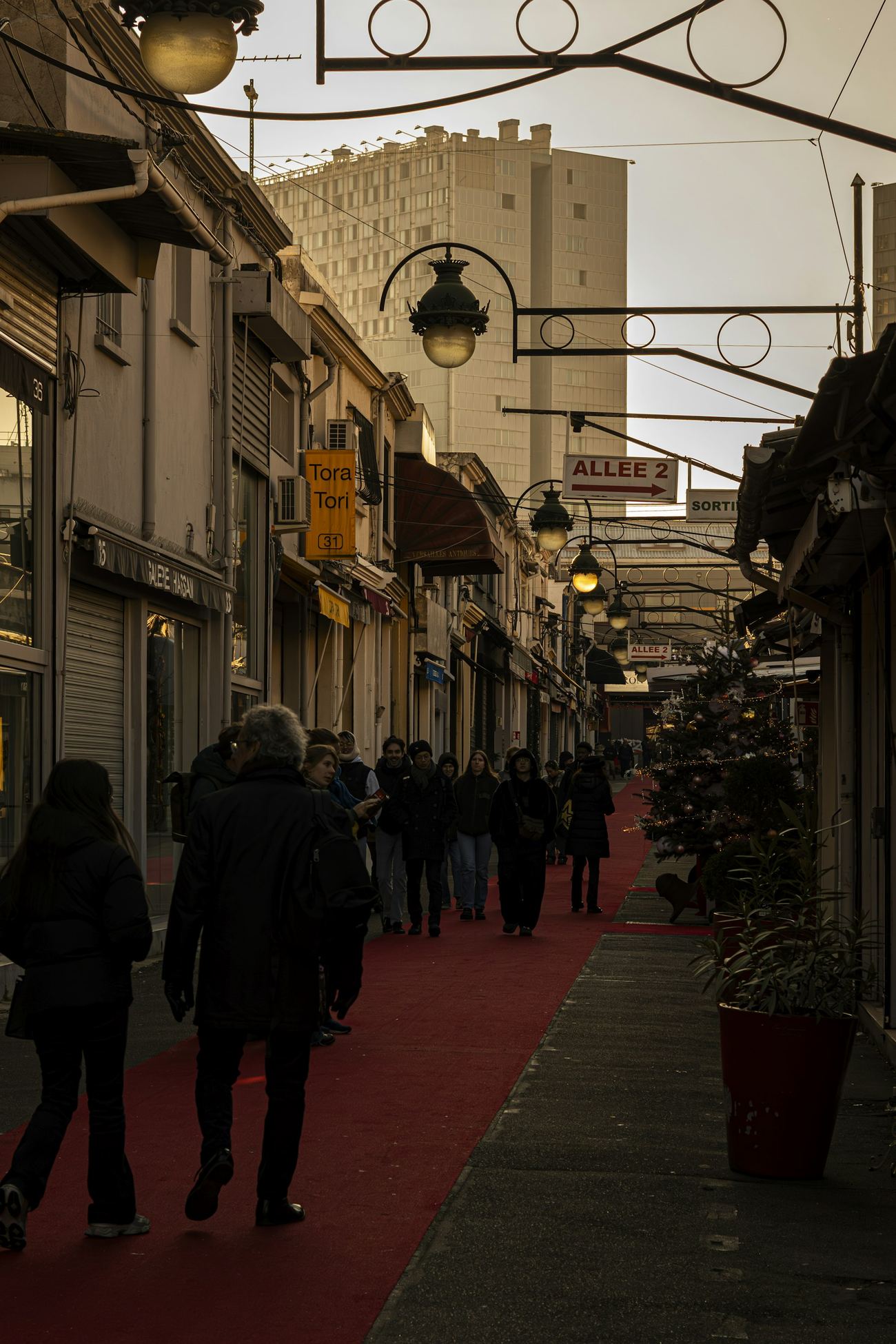
At Paul Bert Serpette, where garden, café and industrial furniture are a staple; at Dauphine; and at L'Usine, the trade warehouse where dealers buy from each other on weekday mornings and larger lots sometimes arrive at once. A lot of 20 or 30 identical chairs is the exception, and when one appears it goes to whoever answers first. Someone on site with your brief agreed can answer first.
How do the chairs ship, and what paperwork applies?
We ship bentwood chairs assembled, because old screws and holes do not survive repeated dismantling. They are wrapped, stacked on pallets or packed in crates, and consolidated with the tables in one shipment. Our shipping guide covers transit times and import duties.
Export paperwork is rarely an issue for a café chair. Leaving France, general antiques over 50 years old need a French export certificate above €100,000 (Ministère de la Culture), and shipping outside the EU, to the US, the UK or the Gulf, requires an EU export licence above €50,000 for antiques over 50 years old (Regulation (EC) 116/2009, Annex I). Both thresholds apply per object. A bistro chair is far below both.
Want us to find yours?
Send us the number of covers, the table height, a photo or plan of the room, the tolerance level you can accept, your budget per chair and your opening date. We take it round the markets and send a video shortlist within 72 hours, each chair filmed from the front, the back and underneath. The restoration schedule follows once the restorer has seen the run. Send the brief.